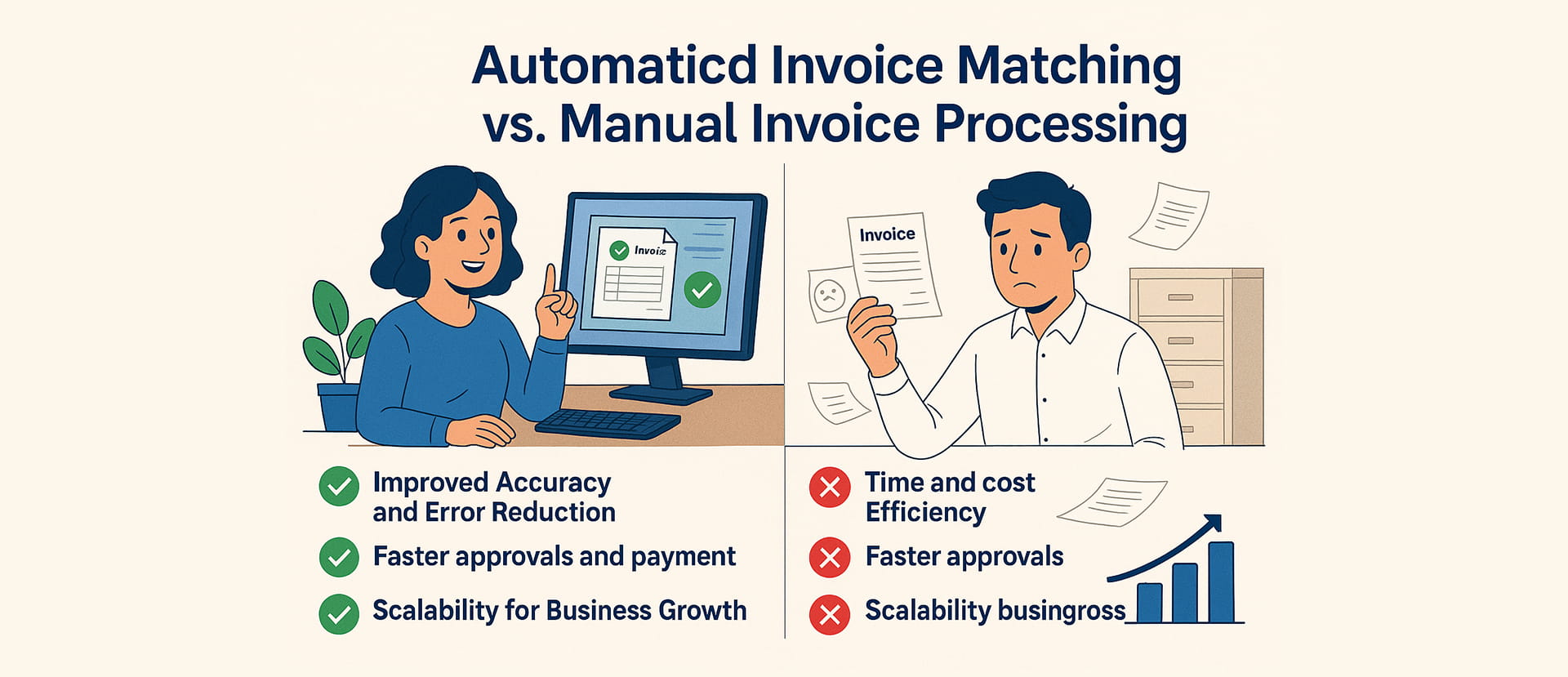
Business Benefits of Automated Invoice Matching vs. Manual Invoice Processing
In today’s fast-paced business environment, efficiency and accuracy in financial operations are more
critical than ever. One area where companies can significantly improve both is in the accounts payable
(AP) process, particularly through automated invoice matching. Compared to traditional manual invoice
processing, automation offers a wide range of strategic, operational, and financial benefits. Below, we
explore how automated invoice matching outperforms manual methods and why businesses should consider
making the switch.
What Is Invoice Matching?
Invoice matching is the process of verifying an invoice against other documents such as purchase orders
(PO) and goods receipts to ensure accuracy before payment is issued. It helps prevent overpayments,
duplicate payments, and fraud. However, the process can become time-consuming, especially as invoice
volumes increase.
This process can be done:
-
check_circle
Manually - involving human intervention, data entry, and document review.
-
check_circle
Automatically - using software that reads, compares, and validates invoices with minimal
human
input.
1. Improved Accuracy and Error Reduction
Automated Matching:
-
check_circle
Leverages optical character recognition (OCR) and AI to extract and match data from invoices.
-
check_circle
Reduces human errors such as duplicate payments, miskeyed data, and incorrect amounts.
-
check_circle
Automatically flags discrepancies for review.
Manual Processing:
-
check_circle
Prone to typos, oversight, and missed details.
-
check_circle
Higher risk of fraud or overpayment due to lack of consistent checks.
Benefit: Automation minimizes costly errors and improves trust in financial reporting.
2. Time and Cost Efficiency
Automated Matching:
-
check_circle
Processes invoices in seconds or minutes.
-
check_circle
Frees up staff to focus on value-added activities rather than data entry.
-
check_circle
Reduces the cost per invoice processed significantly.
Manual Processing:
-
check_circle
Labor-intensive and slow, especially when dealing with large volumes.
-
check_circle
Involves hours of repetitive work and paper shuffling.
Benefit: Businesses can cut AP processing costs by up to 80% with automation.
3. Faster Approvals and Payment Cycles
Automated Matching:
-
check_circle
Supports real-time tracking and alerts.
-
check_circle
Enables faster approvals with digital workflows.
-
check_circle
Facilitates early payment discounts by avoiding delays.
Manual Processing:
-
check_circle
Approvals can be delayed due to lost emails or physical documents.
-
check_circle
Missed deadlines can result in late payment penalties.
Benefit: Improved cash flow management and supplier relationships.
4. Enhanced Compliance and Audit Readiness
Automated Matching:
-
check_circle
Maintains a clear digital audit trail.
-
check_circle
Ensures compliance with tax regulations and internal policies.
-
check_circle
Makes audit preparation quick and stress-free.
Manual Processing:
-
check_circle
Paper-based records are harder to track, store, and retrieve.
-
check_circle
Greater risk of non-compliance and failed audits.
Benefit: Greater transparency and reduced audit risks.
5. Scalability for Business Growth
Automated Matching:
-
check_circle
Can handle increasing volumes without additional staff.
-
check_circle
Easily integrates with ERP systems and accounting platforms.
Manual Processing:
-
check_circle
Not scalable without hiring more staff.
-
check_circle
Bottlenecks increase with business growth.
Benefit: Automation supports long-term growth without proportional cost increases.
6. Improved Supplier Relationships
Automated Matching:
-
check_circle
Ensures timely and accurate payments.
-
check_circle
Reduces disputes and enhances vendor trust.
Manual Processing:
-
check_circle
Frequent errors and delays can frustrate suppliers.
-
check_circle
May damage long-term vendor relationships.
Benefit: Better collaboration and potential for favorable terms.
Conclusion: Automation Is No Longer Optional
In a digital-first world, manual invoice processing is increasingly seen as outdated, inefficient,
and risky. Automated invoice matching not only saves time and money but also improves accuracy,
compliance, and supplier satisfaction. Businesses that embrace automation in their accounts payable
processes position themselves for better financial control, scalability, and competitiveness in the
market.